The ultimate book on Picasso by Victoria Charles
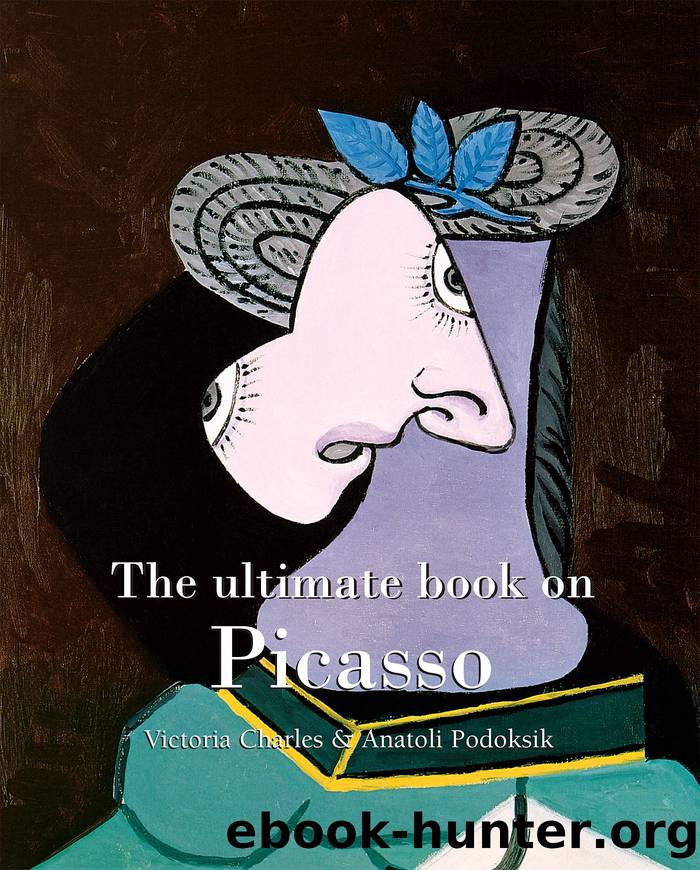
Author:Victoria Charles [Victoria Charles, Anatoli Podoksik]
Language: eng
Format: epub
ISBN: 9781783105014
Publisher: Parkstone International
Harlequin Playing Guitar, 1914-1918. Oil on canvas, 98 x 77 cm. Private collection.
Musical Instruments, 1912. Oil, plaster, and sawdust on oilcloth, 98 x 80 cm. The State Hermitage Museum, St Petersburg.
Bar Table with Musical Instruments and a Fruit Bowl, c. 1913. Oil on canvas, 100 x 81 cm. Private collection.
Clarinet and Violin, 1913. Oil on canvas, 55.3 x 33 cm. The State Hermitage Museum, St Petersburg.
Basically, from the viewpoint of the development of literary methods, the shift from trompe-lâÅil to trompe-lâesprit is the direction taken by Picassoâs evolution of Cubism. The formation of this new creative spirit was accompanied by a renewal of the expressive means themselves and by a realisation of their purity and power. Step by step, Picassoâs Cubism freed painting from optical fiction, in order to make it a plastic language suitable for the creation of visual metaphors, to make it the language of poetry.
The stylistic differences (even contradictions) between the works of the autumn of 1908 and the spring of 1909, discussed earlier, reflect the absence of any one evolutionary direction at the beginning of Picassoâs Cubism (in that sense, Braque has greater integrity and consistency, but is also more formal). Evidently the theme remained the motivating impulse of his art at that time, although it did not always lend itself to verbal expression. âIf the subjects I have wanted to express have suggested different ways of expression, I have never hesitated to adopt them.â[95]
The evolution of Picassoâs Cubism was to assume a certain measure of consistency and logic beginning with the canvasses completed after the summer of 1909, a season spent at Horta de Ebro, to which he returned a decade after the happiest days of his early youth. In Horta, Picasso felt reality with his entire body, with all his senses, with his very conscience; his art once more made contact with his environment.
This contact was, however, effected with the help of his new âopticsâ, which the artist uses to colour his perception in that stern, mountainous country with its pure, chilly air and cubic structures strewn over the rocky slopes.
These âopticsâ were amazingly purist in their simplicity and clarity. They excluded the accidental, the formless and the secondary; they brought order to natureâs chaos and at the same time sharpened to the limit the version of form as the interplay of spatial contrasts, turning a scene into a rich panorama of different aspects arranged according to the character of the subject.
They were to serve as the basis of Cubismâs formal vocabulary. Let us note, however, that the defining of volume by a detailed faceting of the form did not result from a preconceived analysis per se: it came from a feeling for the profound reality of this country, with its landscape baked to a hardened crust under the pitiless light of the Spanish sun. The integrity of that feeling guaranteed the paintings done at Horta de Ebro a certain unity of style, whether landscape, still lifes, or portraits.
Download
This site does not store any files on its server. We only index and link to content provided by other sites. Please contact the content providers to delete copyright contents if any and email us, we'll remove relevant links or contents immediately.
Shoot Sexy by Ryan Armbrust(17732)
Portrait Mastery in Black & White: Learn the Signature Style of a Legendary Photographer by Tim Kelly(17008)
Adobe Camera Raw For Digital Photographers Only by Rob Sheppard(16982)
Photographically Speaking: A Deeper Look at Creating Stronger Images (Eva Spring's Library) by David duChemin(16691)
Bombshells: Glamour Girls of a Lifetime by Sullivan Steve(14081)
Art Nude Photography Explained: How to Photograph and Understand Great Art Nude Images by Simon Walden(13052)
Perfect Rhythm by Jae(5410)
Pillow Thoughts by Courtney Peppernell(4287)
The Book of Joy by Dalai Lama(3994)
Good by S. Walden(3564)
The Pixar Touch by David A. Price(3444)
A Dictionary of Sociology by Unknown(3088)
Fantastic Beasts: The Crimes of Grindelwald by J. K. Rowling(3061)
Stacked Decks by The Rotenberg Collection(2885)
Humans of New York by Brandon Stanton(2876)
Read This If You Want to Take Great Photographs by Carroll Henry(2713)
On Photography by Susan Sontag(2643)
Insomniac City by Bill Hayes(2561)
Photographic Guide to the Birds of Indonesia by Strange Morten;(2538)
